

Cottonwoods
Tree of the West
By Walt Borneman
Editor’s Note: Walt Borneman is a tree-hugger. He is also a superb historian with twelve books to his credit. His current project is a modern history of the Mountain West. He is also a climber who has published several climbing guides, a key participant in the establishment of the Colorado 14ers Initiative, and the American Mountaineering Center, and current president of the Rocky Mountain Conservancy, a recovering lawyer, and the husband of The Flower Lady.
At the risk of being mistaken for Joyce Kilmer, this is about trees. Not just any tree, but my favorite, the cottonwood. Kilmer was an American poet best known for his 1913 piece “Trees,” which umpteen millions of us of a certain age were forced to memorize somewhere during our elementary school years. When Kilmer thought he would “never see a poem as lovely as a tree,” I like to think he was remembering an encounter with a cottonwood.
The cottonwood is truly the tree of the West. Oh sure, there’s a lot to be said for ponderosa pines with their long needles and a sniff of vanilla in their bark. In fact, you are welcome to cast your vote for any coniferous tree, from Colorado’s state tree, the blue spruce, to Nevada’s collection of aging bristlecones. And on the deciduous side, what about the universally beloved aspen? They can be dark and rangy against the low winter sun, shiny green in summer, and golden with splotches of crispy orange and fiery red in fall. But don’t get overly possessive, Colorado. The quaking aspen is Utah’s state tree.
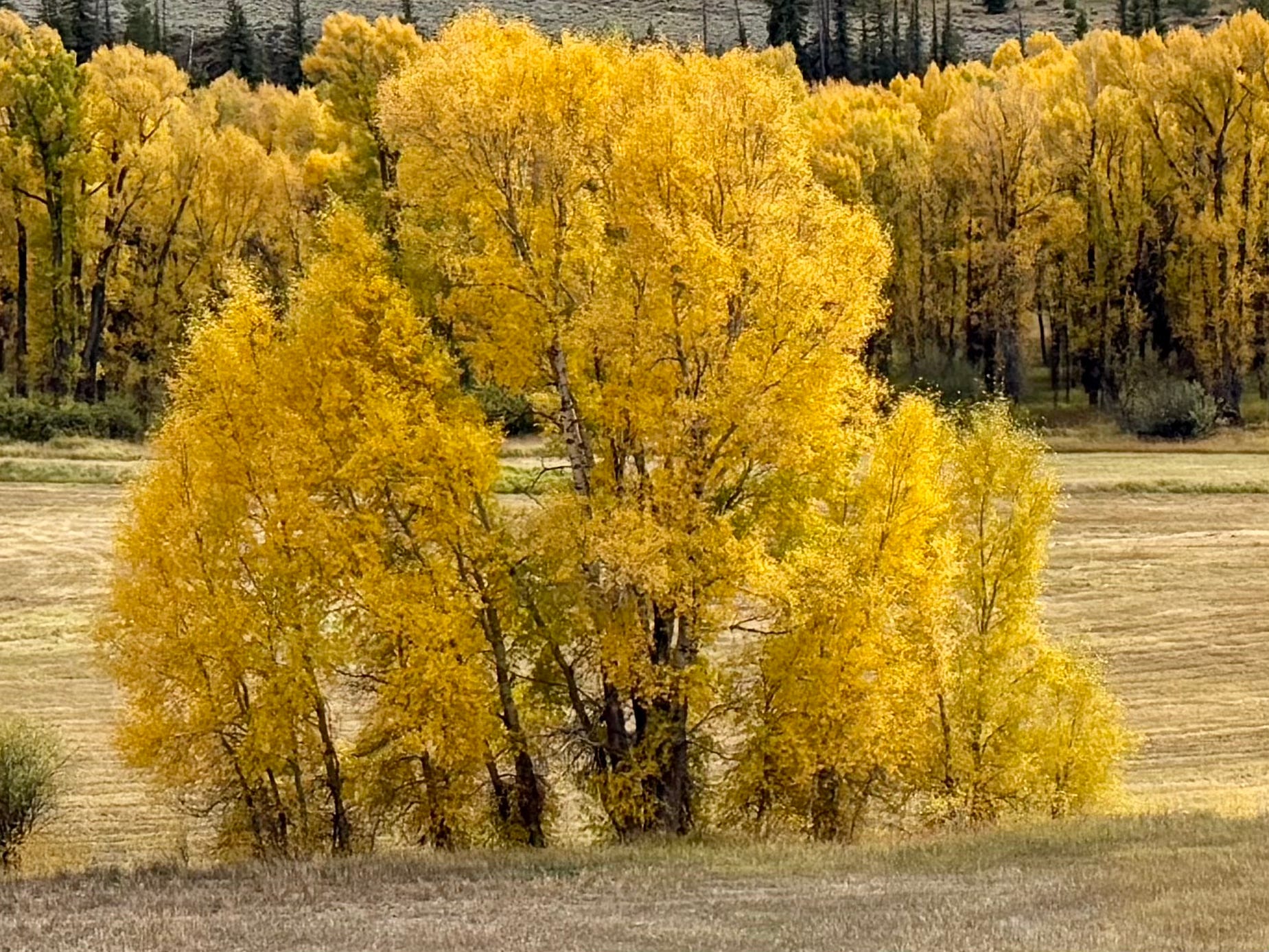
Space does not permit me from confusing myself, and likely the reader, by splitting hairs enumerating the different varieties of cottonwoods. The prairie cottonwood, for example, is the state tree of Wyoming. Suffice to say, a cottonwood is a cottonwood is a cottonwood and grows across the West, in fact across the country. It can be a spreading pillar of grace or a drooping tangle of branches all at the same time. But first and foremost, a cottonwood in any form is symbolic of refuge. Throughout the arid West, it is unquestionably a marker that says, “come on over, you’ll find shelter and shade, and most likely water, at my base.”
What a relief to pioneers crossing the plains in wagon trains to spot a line of green far off in the distance—cottonwoods marking a watercourse, offering a campsite, and sheltering game. Cottonwoods almost always meant good things. It was no coincidence that so many ranches and farmhouses snuggled into their groves. Native Americans camped beneath them first, of course, because what more could they ask? Shelter from wind and sun, a ready wood supply, and a big-game attractor long before Uber delivered groceries to your door.
There is a special grove of cottonwoods along a winding stream just east of Denver that easily conjures up images of an Arapaho or Cheyenne encampment. Thousands speed past daily on a crowded highway with barely a glance, but what memories those stately trees must hold. When I drive by in the fall and see the ground beneath them covered with the fallen leaves of autumn, I can’t help but smell a wisp of wood smoke from long extinguished fires.
Perhaps my favorite stretch of cottonwoods lines the Colorado River through Glenwood Canyon. For years, I drove the two-lane blacktop of U.S. 6 along the river’s twists and turns between Dotsero and Glenwood Springs. Warm sun beating down or full moon illuminating the canyon walls above, the leaves of hundreds of trees rustled in the wind. Slowly in the 1980s, the concrete of I-70 replaced the two-lane and for a time I feared the cottonwoods were doomed. My “Save Glenwood Canyon” T-shirt aside, many of them survived even as the interstate transformed the canyon.
That’s a good thing because cottonwoods can live to be well over one hundred years old. The elder monarchs are frequently as wide as they are tall and shelter mini ecosystems beneath their canopies. They provide habitat for stream creatures such as beavers and muskrats, as well as an occasional river otter. Overhead one hears a cacophony of song before seeing all manner of birds, maybe even eagles and osprey nesting in the crooks of their larger branches. Woodpeckers and red-shafted flickers peck away for insects or drill a home into older snags. Later, finches and wrens are apt to claim these abandoned recesses for their own.
As large as their umbrella of branches appears, cottonwoods have a wide-reaching root system to match. Spreading outward and downward to draw water from the ground, this network of straws also anchors topsoil along the watercourses and nurtures grassy banks and pocket meadows. Cottonwoods themselves consume so much water that there are water law cases arguing that by cutting down a cottonwood, one is keeping water in the watershed that can then be claimed.
The number of cottonwoods cut down for any reason would surely have upset Joyce Kilmer. A German sniper cut him down in his prime while he served with the famed Rainbow Division in the trenches of France during World War I. His last thoughts may well have been of trees.
So, the next time you see a line of fuzzy green off in the distance, take a closer look. It may come into focus as a stand of cottonwoods. If they beckon you over, especially in these turbulent times when we all need a moment’s respite, welcome their invitation. You might just find, as Bob Dylan would likely put it, a bit of shelter from the storm.
Editor’s Afterword: I’m reading Robert Macfarlanes’, Is a River Alive? that posits rivers are an entity, and by extension, all things natural are entities, rivers, mountains, trees. It is a tough idea to get your head around. But not if you have dug in to shelter under a spruce in a blizzard. And sat there in a bevy bag feeling safe and protected from the storm by a sentient being.
If you would like to support more essays from tree huggers please feel free to take out a paid subscription that is only $5 a month Or $50 a year. We are happy to get any level of subscription. And thank you for supporting Mountain Passages.
If you have a Substack account, and would like to help get the word out for Mountain Passages, click on the circle with the arrows to restock this essay or any of the 40 or so essays (mostly true) now available for free on Mountain Passages.
This is mountainpassages@substack.com
I'm a huge cottonwood fan, and I loved this piece.
It's hard to write in an interesting way about trees. I've tried and failed. Your friend Walt Borneman knows how. Thank you.