

Dancing on Ice
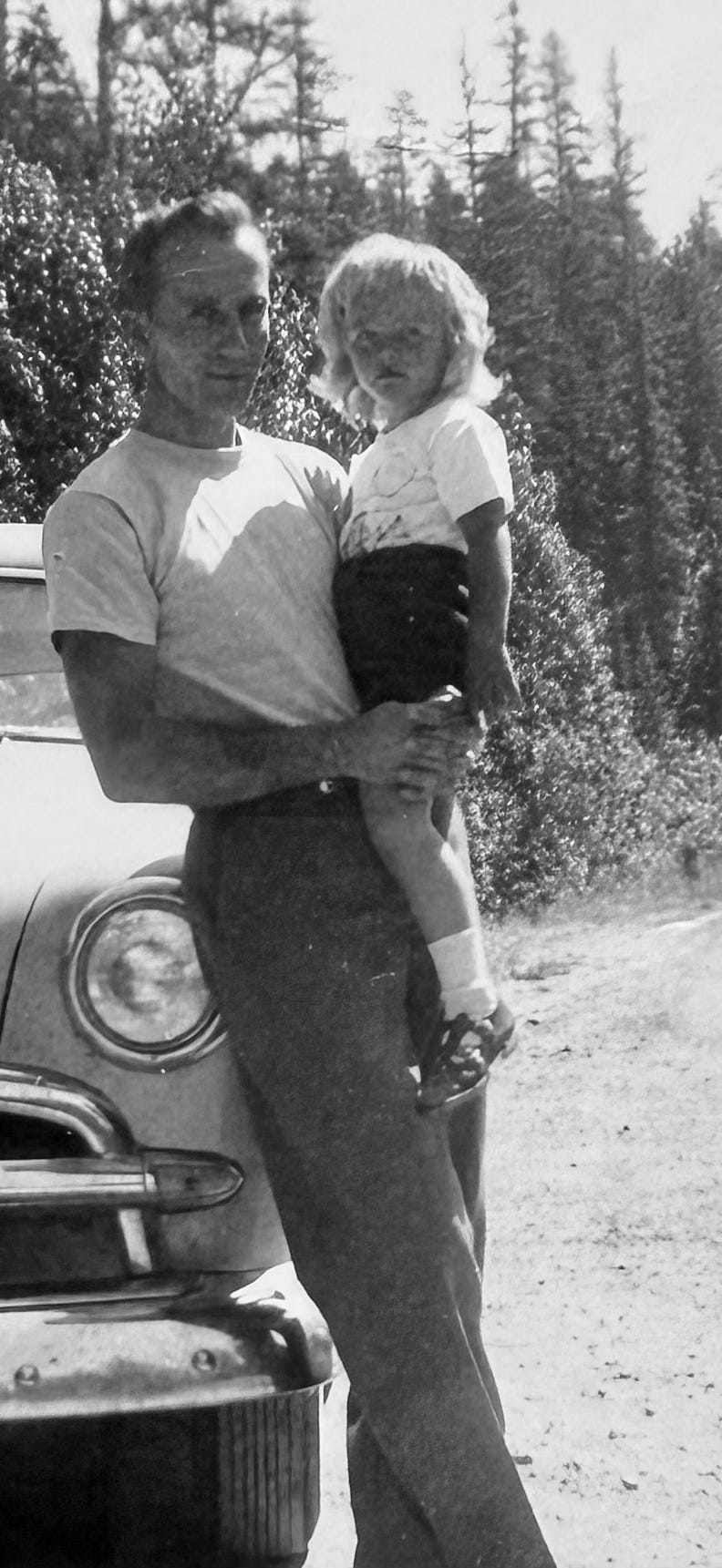
Editor’s Note: Some memories are easy to write about, and some memories are tantamount to chasing down a demon, and when the demon is subdued, wrestling the writing to the ground. Marlene Blessing writes, edits, and coaches other writers from her home on an island in the Salish Sea.
* * *
After almost forty years, I am still haunted by the memory of being invisible at my father’s memorial service. In 1986, at only sixty-seven, he died of a massive heart attack in Anchorage, Alaska. Despite his healthy outdoor lifestyle, years of smoking and drinking had turned his heart into a spongy mass that could no longer beat. The strong woodsman and hunter was gone.
“I’m sorry to tell you this, but your dad passed away today, and we’re preparing to cremate him,” his stepdaughter Dolores said softly on the phone. She paused, then added, “You’re welcome to stay with me if you kids want to fly up here.”
There was so much to digest in what Dolores said. First, he was dead. Not only dead, but relatively young and dead and hundreds of miles north of my home in Seattle. This man who had been a sometimes phantom throughout my life was about to turn to ashes before I had a chance to see him. I felt as if I were lifting out of my own body with this news. As if I must levitate to the very spot where he breathed his last breath.
There was no chance for a final word, for my hand on his cheek to say, “I forgive you. I forgive you for the beatings. I forgive you for your rage. I forgive you for leaving.”
Instead, I summoned all reason to guide me through the details of booking a flight, arranging for a leave from my job, and rallying my brother and sister to come with me on the last pilgrimage for Dad. The tears could wait. Slowly, it sank in that for almost twenty years, my father had been more part of his second wife’s family than he was kin to me and my siblings. When he left my mother in 1964, he chose to throw off everything from that unhappy union, as if he were doffing a worn old coat to be donated to the Goodwill. And we kids were part of that.
Icy Alaska had become my father’s last frontier with his wife, Vanessa, and her daughter and grandchildren. It was his retreat from guilt, a fresh start. It was also, as the Alaskan writer Tom Bodett so aptly put it in the title of his Alaska book, The End of the Road.
I had visited him once the Christmas after my husband died in 1983. I was a thirty-five-year-old widow at the time, trying to cope with the aftermath of loss. In an uncharacteristic gesture, my father called me. “Why don’t you come on up and see us?” he asked, and offered to buy me a ticket. Shocked and pleased, I mumbled, “Uh, yes, that would be great.”
That week with him was a revelation, as he took me on his small tour of “Merle’s Alaska.” I met his new friends, including a bush pilot buddy who flew him over vast areas of Alaska, where the two watched caribou herds traveling, wolves searching for food, and a mother bear with its cubs. He had become a citizen of a wild place that held the enormity of his restlessness. And he had also created a life as a charitable guy who helped build community playgrounds and worked pancake breakfasts to raise money for Shriner hospitals. And, finally, he had become the dance partner of choice for the wives of fellow Lion’s Club members at their parties.
I had my own chance to experience the grace of his dancer’s hold on that visit. He drove Vanessa and me to Portage Glacier on the Kenai Peninsula one day. After we parked the car at a lookout, I stood with him at the railing, gazing down on a brilliant field of frozen blue ice peaks that stretched far. “C’mon,” he dared, and started to walk out to the ice. I followed as Vanessa watched us from the parking lot, her face growing smaller the farther I moved away. I stepped cautiously onto the hard ice, inhaling the sharp, chill air. “Over here,” Dad gestured, reaching out one arm in invitation.
As I walked and slipped my way to his side, he began to smile. It was as if this glacier was his, full of icy blue jewels to dazzle his eldest daughter. King of the Ice, he grabbed me when I got close enough. I gasped as he twirled me around. We’re dancing on ice, I thought with amazement. Dancing! Dad and I. We glided around the blue peaks, his hold and his moves sure. “Merle,” Vanessa yelled, “You’ll break your neck!”
At that, he threw his head back, laughed, and slowed the waltz. For a few brief moments, I had felt the unleashed, irresistible energy of my father. I felt a gentle touch from him. I felt love. These moments would be held in suspension for me over time, a snow globe in which our dance could be captured forever when shaken.
* * *
When we three siblings landed in Anchorage the morning after Dolores’s phone call, she picked us up at the airport and sped us to the funeral home. In a studied hush, the funeral director encouraged each of us to spend individual time with my father’s corpse and say our goodbyes. The crematory fires were being held to allow our farewells. Each of us took a turn in a small basement room, which was kept cool to stall decay. Dad rested on a concrete slab, a light sheet covering his body, his arms and hands resting at his sides.
I noticed how peaceful he looked, how beautiful his face was. All traces of the anger I had witnessed over the years melted like a retreating glacier. The tears flowed as I was filled with an understanding that this man with a restless spirit had once tried to stay with his family but failed. He was not, as my Aunt Fae once explained,
“. . . meant to be a father. Some men aren’t, you know. And your daddy was one of them.”
* * *
As his firstborn, I was both Daddy’s girl and his toughest critic. In the years that followed my childhood, I witnessed him drift away from us, eventually leaving when I was seventeen and almost launched. There was no net that could have pulled him back home. Now, in the presence of his other family, the one that would bury and memorialize him, it felt like I was invisible, as were my sister, Deborah, and brother, Bruce. The two twenty-something step-granddaughters bustled for the next few days, making plan upon plan for the service that would be held. Neither of them talked to my father’s three children. We were polite little monkeys, doing our best not to impose on our hostess, their mother.
The shockwave came the day of the service. As we entered the Lion’s Club hall, an enormous bulletin board rested on an easel by the doorway. It was jammed with photographs that featured my father. There he was, holding a salmon he caught on the Kenai Peninsula. And here, a cozy photo with Vanessa’s two granddaughters, mugging like glamour girls on a beach in Hawaii. “Merle had great legs,” whispered one granddaughter as I looked at the shot.
Arranged like photos on a massive refrigerator door, this was the record of a man who had a full life, surrounded by an adoring family. But nowhere was there a single photo that included me or my sister or my brother. Although my siblings and I didn’t talk about it in the moment, it was a gut punch to each of us. We sat shoulder to shoulder in shock as the service moved along without us. And his widow, Vanessa, who had been in seclusion since our arrival, sat in a row ahead of us, pale and still, her soft white hands clasped tightly in her lap, looking like a trapped bird.
“I didn’t like the guy when I met him,” said the first man to step to the podium. “He just seemed too tough, too full of himself. Couldn’t tell if he was just kidding or meant what he said. But the more I got to know Merle over time, the more I got him. I could always count on him. I loved the guy.”
More tributes followed. The chaplain who visited my faithless father in the hospital recounted, “When I asked Merle if I could pray with him, he had the saddest look on his face. He answered, ‘Well, you can try. But I’m pretty sure I’m just going straight to Hell.’ I took that as an invitation and sat right down with him. I told him God had lots of room for sinners. Including him. We had a good, long talk about life.”
I wished I could say that. I wished I could say anything. I sat frozen, reeling off a lightning round of memories in my head. Flash: Dad beats me when I’m three for wetting my bed. Flash: Dad buys me the English racer bike of my dreams when I’m eleven. Flash: Dad beats me for the last time when I’m thirteen for exiting a theater with my girlfriend ten minutes late. Must have been fooling around with boys. Flash: Dad promises to make sure I can go to college because I’m such a good student. Flash: Dad hands me $20 toward my college education, and that will be all.
For the several days before the memorial service, the energetic step-granddaughters had been rehearsing songs. Wedged between strangers at the service, I wanted to leap out of my seat and run for the door when I heard their dulcet tones. They trilled a country-western medley to honor my father’s love of that music. Truth is, only buxom Dolly Parton or hard-living Merle Haggard with his “White Line Fever” would have soothed my father on his way to heaven or hell.
At the mourners’ reception at Dolores’ home, the dining room table was extended and spread with comfort food: bowls of mixed nuts, pound cakes and banana bread, small crustless breads cut in heart shapes and slathered with cream cheese and crab, arrangements of celery stalks and carrot slices, and a huge tray of sandwich meats with bread and condiments. I studied this table because I was having trouble saying anything to the strangers in the home. Inanimate objects were more my speed.
Suddenly a man who had spotted me at the table gallantly made his way from the living room to my side. “Hello. My name is Jim. I worked with Merle. Great guy. Drove more than fifty miles in a blizzard once to help me get my truck started and chain up. How did you know him?”
“I’m his eldest daughter,” I said slowly. My voice was flat, and the man sensed I was struggling to keep from showing what I felt.
“Ah, Honey. That’s rough,” he said simply. Then he reached out, lifted one of my dangling hands, and squeezed it gently. He was tearing up.
“He was real proud of you, Marlene. Talked about how you got degrees and were making something of yourself. ‘Much better than the Old Man,’ he would say.”
I have saved these breadcrumbs from a stranger all these years, along with my memory of dancing on ice with my father. There is no undoing the bitter and the sweet of that funeral memorial. I have long since lifted the silent curse I once laid on the party-planning step-granddaughters for their insensitivity. And I no longer hold an imaginary fistful of snapshots of him and me to plaster atop the Alaskan family photos on the bulletin board. Instead, I fix my vision on the icy Alaskan dance floor, the spectacle of jagged blue spires pointing up to the skies, and my complicated dance partner beckoning to me to dance again.
###
Editor’s Note: Thank you for reading Mountain Passages. We are an assembly of wordsmiths who write essays to entertain, and if we are lucky, essays that pop back into your consciousness at unexpected moments, and make you think about a subject in a new way, or at least smile. We also write because we can’t help ourselves—we simply enjoy the magic of words flowing from our fingers onto paper or a screen—and on rereading, finding unexpected thoughts and ideas. We hope you enjoy reading our essays as much we do writing them.
Your comments and subscriptions keep us writing. Unfortunately, only paid subscribers may use the comment button below. Free subscribers, please send your comments to alanbearstark@gmail.com
There is no better way to spread an idea, a thought, or just a laugh, than through word-of-mouth to family, friends, and colleagues. In this digital age, the best way to do that is by using the share button below.
Substack is a business that exists by deducting a portion of a subscription to keep their business running. Thank you for your paid subscription to Mountain Passages. It is $5 a month or $50 a year. There is also a FREE subscription available for Mountain Passages. Just scroll through the subscription page until you find it. A paid or free subscription may be canceled at any time.
We are mountainpassages@substack.com
Still reeling from this story. I have a similar story although my Dad tried a lot harder to maintain a relationship and be there. There was no shared custody in those days. Dads just disappeared, later remarried and that family became numero uno. It’s painful and we do try our hardest to gather a few good memories. He was proud of you as he should be. Beautifully written Marlene.
A truly bittersweet story. Emotions run the gamut. I can only imagine how difficult it was for her and her siblings. Thank you for sharint.