

Steve Komito
Boots on the Ground

Editor’s Note: A life well lived, doing one thing better than anyone else. A Walt Borneman essay.
* * *
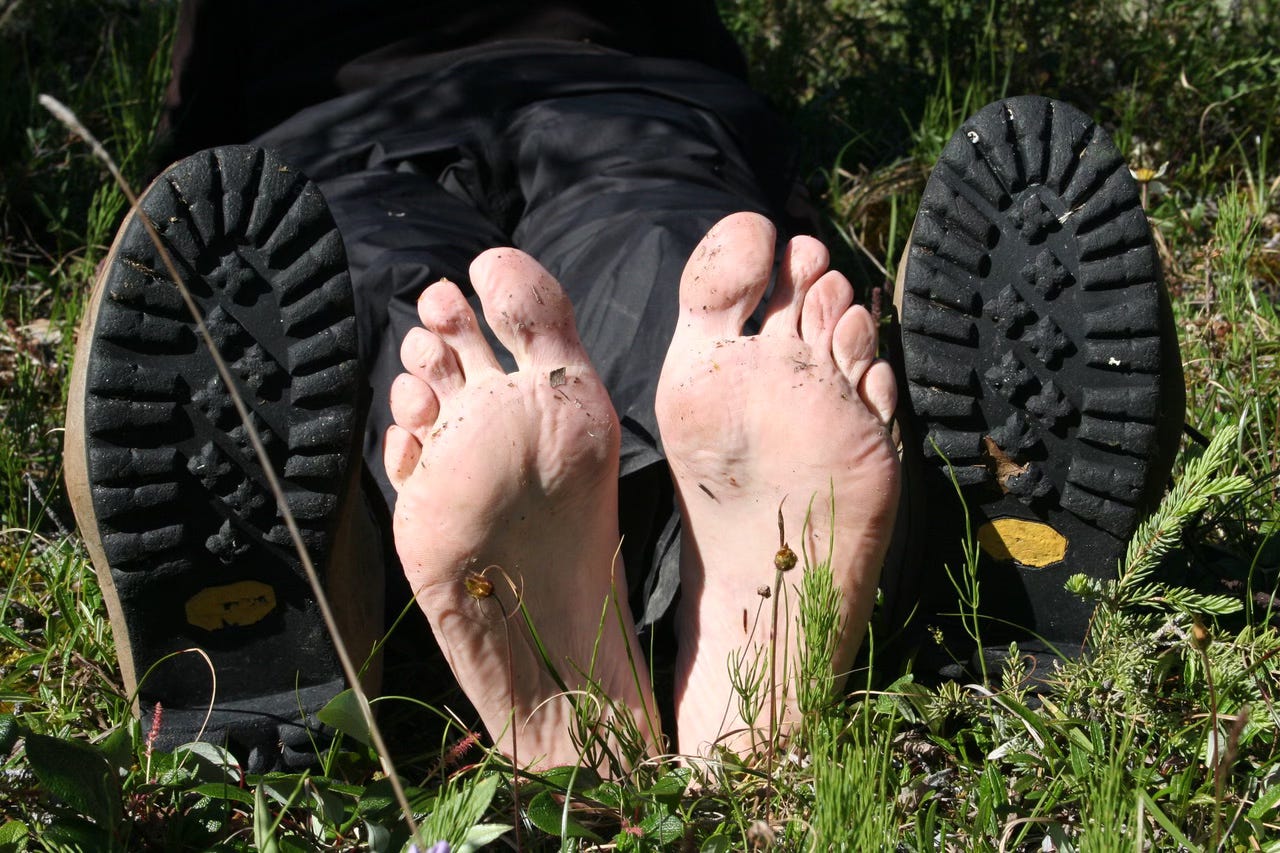
If you took every sole Steve Komito ever worked on and put them heel to toe, the line of boots might extend from Longs Peak to the Flatirons in Boulder. Even if you don’t know Steve, odds are you have heard about “the guy who repairs boots in Estes Park.” This past year, Steve Komito finally hung up his cobbler’s apron and closed the door to Komito Boots after six decades of repairing all manner of hiking and mountaineering footwear.
My boots met Steve long before I did. During the 1980s, one could drop off boots in need of new Vibram soles—I had Lowa Civettas at the time—at Neptune Mountaineering in Boulder. After a trip up the hill to Estes Park, they would reappear at Neptune’s ready for the next season. But that’s getting ahead of the story.
Stephen Leonard Komito was born in Fort Wayne, Indiana, in 1941. His parents took him and his brother on road trips in the 1950s and on one of them, Steve got his first look at Colorado. “I was smitten,” he recalled. “This was the sort of place I wanted to be.” Later, a YMCA trip to the Tetons introduced him to mountaineering and confirmed what he wanted to do.
Steve endured two years at the University of Miami before transferring to the University of Colorado in the fall of 1959. He found Boulder filled with climbers and he immediately joined the Colorado Mountain Club. Under parental pressure, he stuck with science studies but found, as he put it, “conflict between academics and recreation.”
Dropping out of CU, he went to work as a shipping clerk for Boulder outdoor innovator Gerry Cunningham at his retail shop on the hill. “Boy, was I happy,” Steve reminisced. “I met a lot of mountain climbers and girls! Even girls were mountain climbers!” Every hour he wasn’t working, he was out on some crag or peak with an ever-growing circle of companions.
Working construction one fall in Jackson Hole, Steve was summoned to the telephone. Exum Guides was already closed for the season and an old man with a German accent needed a climbing partner. The next day Steve found himself climbing classic Irene’s Arete with Fritz Wiessner. Best known for an early ascent of Devils Tower and a pioneering near-miss on K-2, Wiessner led the entire climb. When Steve expressed concern about being caught on route in the fading twilight, Wiessner shrugged and told him, “When you’ve been in the mountains as long as I have, you know this ledge will go around.” It did.
Barely into his twenties, Komito became a climbing partner of bricklayer-turned-climbing sensation Layton Kor. On Sundance Buttress on Lumpy Ridge above Estes Park, Komito and Kor put up a 5.10 route in November 1963, the weekend after John F. Kennedy’s assassination. According to Steve: “When Layton and I did that route, he said, ‘What should we call it?’ and I said, ‘Well, because of the events of this past week, let’s just call it ‘Mr. President.’”
Steve also climbed first ascents in the Utah desert as Kor’s second, including Standing Rock and the Mitten Thumb. When Kor couldn’t find someone of his caliber to climb with him,” Steve recalled. “My job was simply to belay him as he disappeared overhead on a new route and then follow him up.”
Soon enough, the economic realities of a wife and daughter pushed Steve to double down on a trade skill. He enrolled in night classes at the Emily Griffith Technical School and in the post-Sputnik rush, took the one course devoid of science—shoe repair. He quickly realized, Steve claimed, “this ain’t rocket science.”
But it did contain a specialty, and Steve focused solely on repairing climbing shoes. With $3,000—all borrowed, including $1,000 from Yosemite legend Steve Roper with whom he had climbed—Komito opened a boot repair shop on North Broadway in Boulder with, he confessed, “just enough knowledge to know where to get materials and the necessary equipment.”
But the mountains were calling him closer, so in 1971, Steve and his young family moved up the hill to Estes Park. Real estate transactions were simpler then. He traded a Boulder mobile home for a house overlooking downtown Estes Park that was owned by an elderly man needing to move to a lower elevation. They simply took over each other’s loan.
Steve’s first shop in Estes, what he called “a shack,” offered both repair services and retail sales. My wife, Marlene, newly arrived from Louisiana to work at the local Y-camp, bought her first pair of hiking boots there in 1974.
Over the ensuing decades, Komito Boots became the go-to place for reporting first ascents, hooking up with climbing partners, and asking about route conditions. Name a person of mountaineering note in Estes Park or Colorado, or even well beyond, and it is likely Steve Komito’s hands have been on their soles. He became indelibly tied to Colorado and the West’s climbing history. Anyone asking Steve to put a heel on a pair of cowboy boots, however, was quickly and firmly told he only worked on mountaineering boots.
For all the legends who passed through the door of his shop over the years—one of his best friends was Tom Hornbein. Komito and Hornbein became acquainted when Tom walked into the Komito shop one summer with his kids in tow. At the time, despite Hornbein’s legendary West Ridge of Everest climb, Komito claimed he had “never heard of him.” They continued to climb and ski together well into their senior years, including one outing that became infamous because of a forced bivouac on the southwest ridge of Pagoda at the head of Glacier Gorge in Rocky Mountain National Park.
I have lost track of how many re-soles Steve has done for me over the years, not to mention a few stitches or drops of shoe glue here and there. But Steve had his limits. “You do what you want, Walt,” he once told me before we embarked on a trip, “but I won’t re-sole these again.” I took his word for it and left my boots in Africa to the gratitude of one of our porters.
Given enough time, dust gathers on all our souls. In the summer of 2025, after fifty-four years as an Estes Park businessman, Steve Komito decided it was time. He closed Komito Boots. Steve’s seen a lot of changes in mountaineering technique during his life, but he managed to live most of it among the mountains that first called to him. Best of all, he can still look out his window in his home and see Longs Peak.
END
Editor’s Endnotes: Thank you for reading Mountain Passages. We are an assembly of wordsmiths who write personal essays to entertain, and if we are lucky, essays that pop back into your consciousness at unexpected moments, and make you think about a subject in a new way, or at least smile. We also write because we can’t help ourselves—we simply enjoy the magic of words flowing from our fingers onto paper or a screen—and on rereading, finding unexpected thoughts and ideas. We hope you enjoy reading our essays as much we do writing them.
If you would like to help us at Mountain Passages simply refer a friend(s) with the button below. Write a short note and then send it. The friend(s) can check-out Mountain Passages, and maybe sign-up for a free subscription or they can simply ignore your suggestion. No foul, no penalty.
 | A guest post by
|
I didn't realize he was a world class mountaineer. He revived more than one pair of my boots.
I am glad he can enjoy retirement!
There is also a great shoe and boot repair craft store in Nederland called Perry's. I highly
recommend them for your hiking or ski boots.
Loved this portrait of a craftsman who found his niche at the intersection of passion and practicality. The detail about refusing cowboy boots shows how deep specialization can create real value in a comunity. Reminds me of an old ski tech I knew who could tune edges better than anyone but wouldnt touch snowboards on principle.