

Substack Epistolary
An Old Form on a New Platform

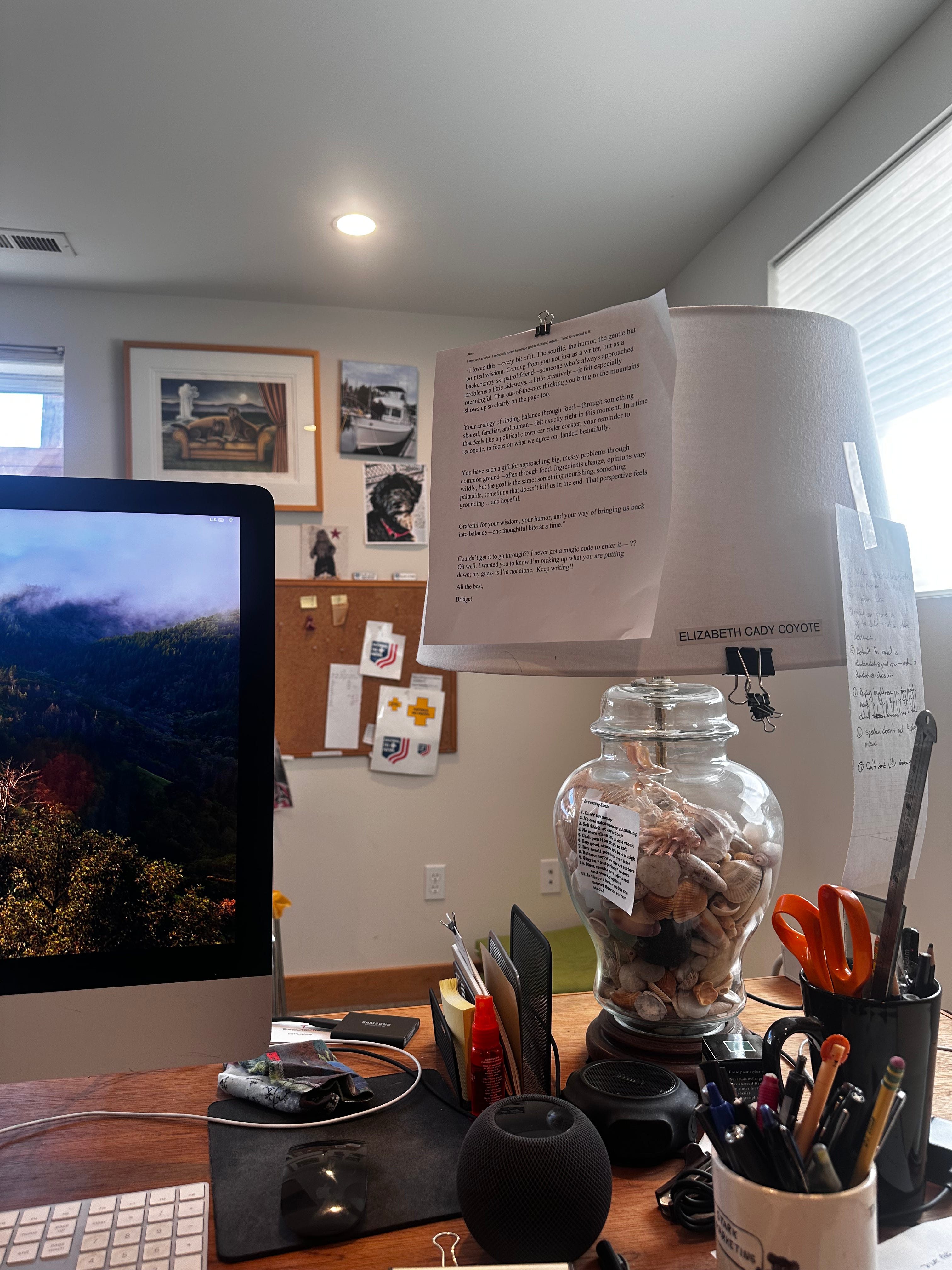
Alan-
I loved this—every bit of it. The soufflé, the humor, the gentle but pointed wisdom. Coming from you not just as a writer, but as a backcountry ski patrol friend—someone who’s always approached problems a little sideways, a little creatively—it felt especially meaningful. That out-of-the-box thinking you bring to the mountains shows up so clearly on the page too.
Your analogy of finding balance through food—through something shared, familiar, and human—felt exactly right in this moment. In a time that feels like a political clown-car roller coaster, your reminder to reconcile, to focus on what we agree on, landed beautifully.
You have such a gift for approaching big, messy problems through common ground—often through food. Ingredients change, opinions vary wildly, but the goal is the same: something nourishing, something palatable, something that doesn’t kill us in the end. That perspective feels grounding… and hopeful.
Grateful for your wisdom, your humor, and your way of bringing us back into balance—one thoughtful bite at a time.
I wanted you to know I’m picking up what you are putting down; my guess is I’m not alone. Keep writing!!
All the best,
Bridget
* * *
Bridget,
So you signed up for a Substack account. Good. Having worked with you, I know you have something to say—sometimes pointedly. Most important of all, I know that once you have a project in mind, you are fiercely relentless in making that project come to life.
Several months ago you sent me an email about a piece I wrote for Mountain Passages called A Recipe for Leadership that was posted on January 11. It was such an engaging, encouraging, and totally unexpected note, that I printed it and hung it from the lamp beside my desktop computer.
You can write.
Let me quote from the letter to show how well you write, “Your analogy of finding balance through food—through something shared, familiar, and human—felt right in this moment. In a time that feels like a political clown-car roller coaster, your reminder to reconcile, to focus on what we agree on, landed beautifully.”
There are times when I am wordlessly staring at a blank computer screen for what seems like hours of time. I would love to be able to spin off a paragraph like that with the apparent ease with which you write.
It would be nice to think that Substack was just about writing, but starting a newsletter is exactly like building a business. It takes a plan, energy, intensity, and a significant amount of time.
When you took over as director of Brian Mountain Nordic Ski Patrol, there was an immediate change in the tone of the meetings from a kind of loquaciousness to, “here is what we are going to get done on the tracks and in the backcountry.” You came to the job of patrol director, on top of your day jobs as a CEO of Green Girl Recycling, and a lacrosse mom, with a plan in mind, and then you lined up all of us to execute that plan. I was impressed.
So you have everything it takes to get a great Substack going, except maybe time.
Here are some unsolicited thoughts on getting started:
First, the Substack platform is difficult to maneuver through, or at least it is for me. The customer support is just a huge bank of FAQs that never seem to completely answer my question(s). So if I get in some sort of a bind on the platform, I just muddle through it. I often wonder if my subscription growth has been impacted by my ineptness.
One of the writers for Mountain Passages has enlisted her hubby to operate the backend of her Substack so that she can focus on writing.
Second, I think that success on Substack requires a focused newsletter. Mountain Passages isn’t really focused other than being a platform for personal essays. It’s my choice to go against the proven success formula, but then I often go my own way for the fun of it.. My goal is to entertain first and maybe help readers look at the subject in a different way. We’ll see if going my own way works—for sure, it has clearly taken longer to build Mountain Passages than I suspect it would have been, had I been more focused.
You have recycling to write about. If I were you, I would start there with essays from your experience at GGR or expansion of your blogs from the GGR website, and then expand to other subjects as you go along.
Third, there are millions of Substack subscribers. I have no idea of how many of those subscribers also post on the platform. But assume that millions post at least occasionally, and therein lies the competition. Right now I have almost 600 subscribers, of which I’m guessing 200 or so occasionally read my essays. An essay takes me anywhere from six to ten hours to write and rewrite by the time the editors have their way with my words (we have two editors at Mountain Passages who work hard to clean up the essays).
That’s a lot of work for a limited readership. But I imagine 200 people sitting in a room listening to me read an essay. That is an amazing image to think about. I simply have a clear idea of what I want to do with Mountain Passages, and week after week I proceed with the plan. If the readership increases, great. But touching 200 people with my work is a huge reward along the way.
Fourth, There is a hard truth about Substack readers. Sometimes I think they have the collective attention span of a puppy as they scroll through posts in fractions of a second that have taken writers hours to compose.
One of the many unintended consequences of untethered digital innovation is that there is just too much stuff out there to process. If we are online, we have information/entertainment coming at us at warp speed—we are often overloaded. But there is an antidote to this malaise that can be defined in one word: quality.
I’m not taking my dog-eared copy of Zen and the Art of Motorcycle Maintenance and thumping it on my desk like a Bible on a pulpit. But if we take the time to write the best personal essays that we can. If we keep searching for new ideas and new writers. If we are persistent and continue to show up week after week. Mountain Passages will be worth our thoughts, words, time, and energy. And if we fail, it will not be because we spent our time scrolling on the couch. We wrote something that we hoped would last.
Fifth, I post other writer’s essays on Saturdays at 6pm mountain time and post my essays at the same time on Sunday night. I start working on the next essay Monday. Sometimes I have a first draft in a day or two. And then I reread it and find myself in the rubble at the base of the Wall of Doubt.
“Who the hell would want to read this?”
“Unadulterated dreck.”
“Godzilla could write better stuff than this with one stubby paw behind her.”
The solution is as obvious as it is simple. Push through the doubt, write what has to be written in the best way to write it. Finish the draft, edit and rewrite, finish the piece, let it sit for a day or two, do some touch-up and post it. Then move on to the next essay.
Last, write some essays for us, repost them on your newsletter. That way you can focus on writing. This is my long-winded call for you to join us as a writer for Mountain Passages.
You have my email.
Best,
Alan
###
Writer’s Note: This personal essay is an experiment using an 18th Century literary form called epistolary. This means that instead of using a narrator to tell a story, the story unfolds through an exchange of letters. I have monkey-wrenched the form into a personal essay to replace the first person narrative that is usually the form used for personal essays. Not surprisingly, this made a Mountain Passages editor uneasy. She suggested that I introduce the idea of epistolary before diving into it. Nah, Mountain Passages essays are often about just diving into something. Today’s question (to all three of my regular readers) is simply: Did this essay work for you? Please comment below or text me at 720-810-0071.
COMMENT
Subscribe