

Waiting on the Bell

Editor’s Note: If you have ever traversed a “knife edge” in the mountains or, in my case, crawled across a knife edge, you will enjoy writer Walt Borneman’s essay. And if you have exercised common sense and avoided knife edges in your life, you will still enjoy this piece.
* * *
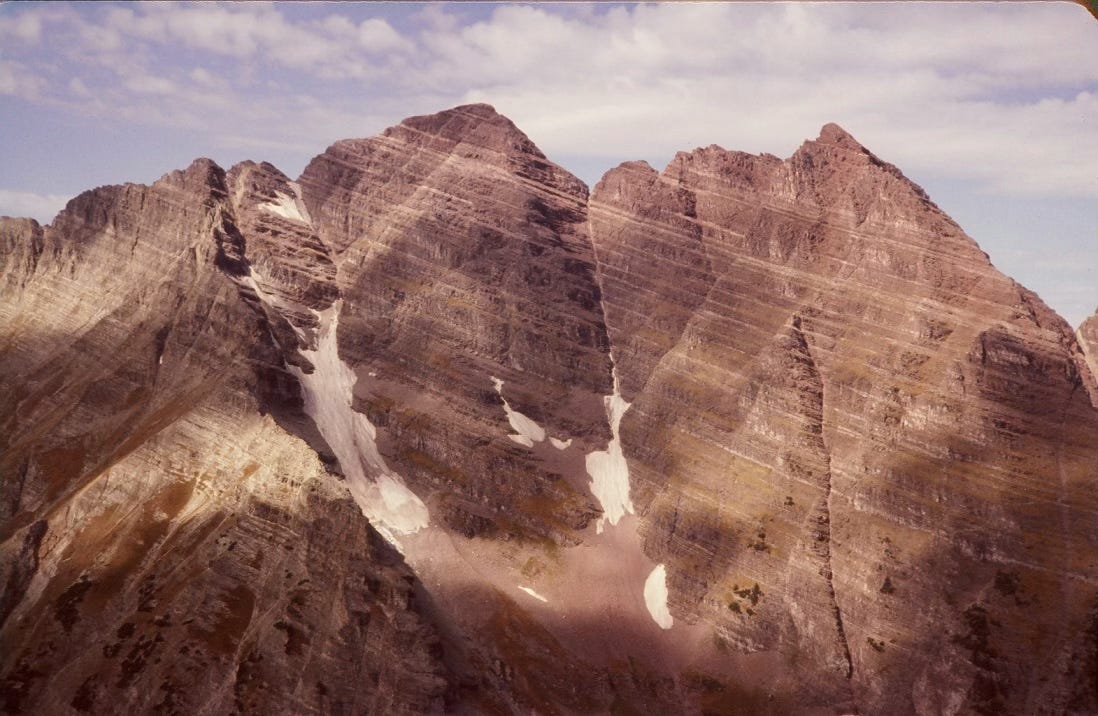
Late in August 1980, I found myself kicking steps in the snow up a narrowing couloir on the side of Colorado’s famed Maroon Bells. Three years before, I had climbed the North Maroon Bell via its standard northeast ridge route, but weather precluded venturing across the airy, crumbling knife edge to its southern twin. My haste to climb the South Bell this day was twofold.
First, I was the co-author of A Climbing Guide to Colorado’s Fourteeners, published in 1978. Despite my best efforts, I had climbed only fifty-two of the fifty-four summits included in it. Second, the far more pressing matter was that in just two days, my long-time climbing companions, Omar Richardson and Gary Koontz, were rendezvousing with me to climb what would be their final 14,000-foot summit. Somehow, despite having climbed almost fifty fourteeners with Omar, I had been left to my own devices on the Bells and now the countdown was tolling.
Overhead, dark clouds rose above the red ridges that gave the peaks their names. It was hot; in the lee of the ridge, it was still—perfect thunderstorm weather. A few minutes later, booms gave credence to that prediction. I did the only thing that made sense—both at the time and now—I turned around and went down. Two days later, high above Como Basin, Omar, Gary, and I celebrated on the summit of Little Bear—their fifty-fourth fourteener, my fifty-third.
The years went by. I continued to revise the guidebook—relying on the indefatigable Jim Gehres for the South Maroon Bell route description. In the interim, thousands, then tens of thousands of people, made their way up Colorado’s fourteeners. It was a far cry from the summer of 1972, when Omar and I climbed seventeen fourteeners and encountered just two other people—not on a particular peak, but for the entire summer. I climbed many of Colorado’s other peaks, explored places best unsaid, and made many trips to the Tetons and Sierra Nevada. But the South Bell remained unclimbed—at least by me.
For years I thought about it only when asked, usually in the context of a guidebook discussion, “You’ve climbed them all, of course?” If the occasion allowed, I told the whole story—“all but the South Bell.” But frequently the moment permitted only a nod or a mumbled “sure,” with only me knowing that the South Bell remained to be climbed.
By the 1990s, the questions were increasing because the number of climbers on these summits was mushrooming. The tens of thousands gave way to hundreds of thousands every summer. “Damn this fourteeners craze,” I thought. “I’ll show them! I will never, ever climb the South Bell. It will always be the one I have left to do.”
I watched people blitz through the easy ones and then slow down as they tackled the hardest dozen. “Only four to go,” they’d say. “Down to the last two.” Then victory—they’d climbed them all, and few of the successful even came to my house to have me sign their copy of my book. They were ecstatic, but I remained smug. I hadn’t climbed them all, and I was mighty glad.
Then, one day I went with Jim Gehres to climb Snowmass Mountain—my second time, his twelfth. Jim introduced me to Marlene. Snowmass was Marlene’s thirtieth fourteener. By the time we were married, she had only two to go.
Marlene had summited South Maroon Bell with Jim several years earlier, but one of the two she had left to climb was the North Bell. I still eschewed South Maroon, but what if I ended up with her on the North Bell only 700 yards—albeit a rugged 700 yards from South Bell summit, including the ups and downs of the knife edge and a good deal of exposure?
In August 2004, twenty-four years after I turned around in the snowy couloir, the question was answered. Marlene and I started up the North Bell with Estes Park climbing legend Mike Caldwell and the ever-reliable Omar. The morning was pristine, the route on the North Bell much better defined—some would say, much more maligned—than on my first visit.
We traversed the big ledge, scampered up the two main couloirs, split a twenty-foot crack on the summit ridge, and followed a lone mountain goat to the summit. Wow! Great views and Marlene’s fifty-third fourteener.
Clouds were beginning to build, but we still had a couple of hours. There was a decision to be made. Was it time to climb my final fourteener? Mike looked over at the South Bell and said that he’d go over there “in a heartbeat.” Omar quizzed me about any philosophical objections to making the traverse and finally climbing the South Bell. Marlene was dubious, but clearly outvoted. Off we went.
“One and a half hours,” we said, “two at the max.” Time enough. But the brewing clouds were on a different schedule. Two hours came and went. Later, pointing out the prominent short cliff right in the middle of the knife edge that we had down-climbed with the aid of Mike’s belay, I told Marlene that no one could ever say that she hadn’t been right about staying right on top of the knife edge.
Finally, we reached the low point and started up the South Bell proper. Graupel—that cross between snow and hail—hit us, and the roll of thunder continued. But it really didn’t matter. There was no place to go but up. We scurried up another small cliff and reached the slabs of the South Bell’s summit ridge.
Later, Marlene would adamantly declare that there had been plenty of time for photographs. But on that day, she offered no complaint as we simply walked quickly across the summit of the South Bell and continued down its south ridge. It was not the time to be the highest thing around. Twenty-four years in coming, less than twenty-four seconds in passing. Somehow that seemed appropriate.
End
Walter R. Borneman is the author of 14 books, including The Admirals: Nimitz, Halsey, Leahy, and King and Polk: the Man Who Transformed the Presidency and America. His newest book, Reckoning: The American West on Edge will be published in Spring 2027 by the University of Utah Press. He lives with Marlene in Estes Park.
* * *
Editor’s Notes: Walt’s book, along with guidebooks by Gerry Roach and Lou Dawson, ignited the fourteener craze.
Have you ever put off something for a number of years? For what reason? We would like to hear from you. We would like to hear your thoughts, which will appear at the bottom of this essay as comments. We almost always comment back.
We understand that times are hard now that buying subscriptions has lost out to gas, food, and mortgage, or rent. A free subscription to Mountain Passages is available. We publish two original personal essays a week and are considering moving to three short essays a week. Your subscription is a vote against “reels” of fools leaping from cliffs and podcasts by know-nothings and a vote of confidence for the short, personal essay.
If you are a member of Substack (and you should be writing and posting on Substack, shouldn’t you) just click on the circle made of two arrows to “restack” this essay on your page.
You can share an essay with a friend or your entire posse by clicking the square with the arrow above it or the button below.
Thank you for reading Mountain Passages. We are mountainpassages@substack.com
 | A guest post by
|
Longs has the highest number of fatalities and is very accessible.
I agree. Most 14teeners have high exposure high risk parts of the route. One stumble or slip and you’re history. Especially when it’s storming and the rocks are wet. We also had some crazy scree descents.